
The World Conference on Sustainable Tourism ST+30 brought together institutions, experts, and industry leaders in Lanzarote to commemorate the 30th anniversary of the First World Charter for Sustainable Tourism and to present its updated version, the World Charter for Sustainable Tourism 2025 — a document that renews the global commitment to responsible, regenerative, and inclusive tourism.
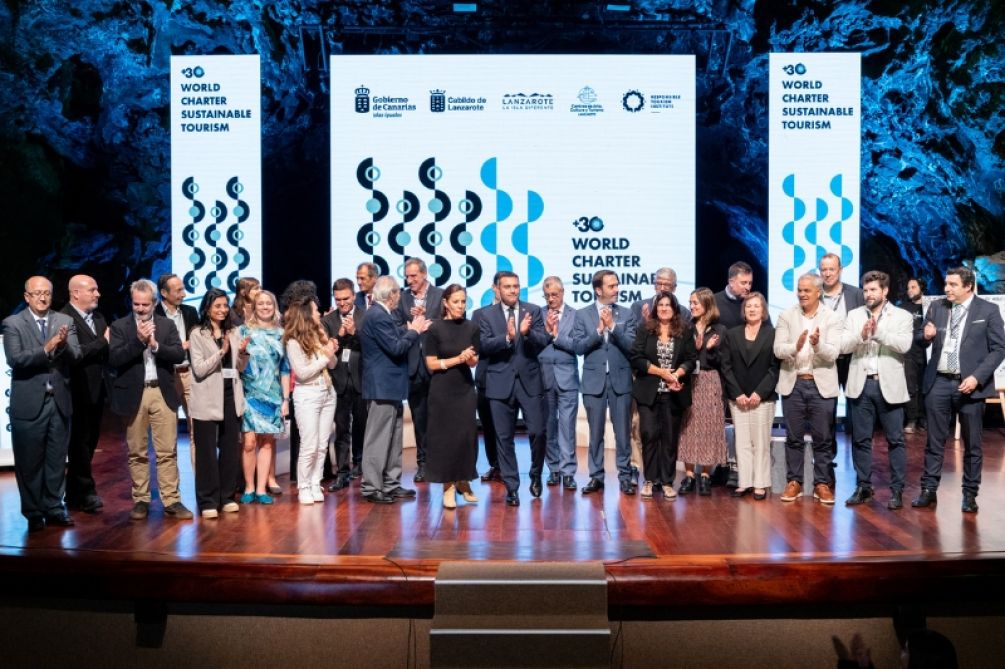
Thirty years after the 1995 Charter, the island once again became the global epicenter of sustainable tourism.
The island of Lanzarote hosted the World Conference on Sustainable Tourism ST+30 this Friday, November 28, 2025, in the iconic Jameos del Agua, a historic event that commemorated three decades since the First World Charter for Sustainable Tourism, drafted in this same place in 1995.
Throughout the day, representatives of international organizations, public administrations, tourism companies, and experts came together to reflect on the challenges and opportunities facing global tourism in its transition toward a fairer, more inclusive, and more responsible model.
Promoted by Turismo Lanzarote, the Cabildo de Lanzarote, Turismo de Islas Canarias, the Government of the Canary Islands, UNESCO, and the Responsible Tourism Institute (ITR), the conference brought together key international figures and served as the stage for the public reading of the World Charter for Sustainable Tourism 2025.
This document updates the commitments adopted in 1995 and reaffirms Lanzarote’s global leadership in sustainable tourism.
The new text consolidates the principles of environmental, social, and economic sustainability, adapting them to current global challenges such as climate action, digital transformation, the regeneration of natural resources, and responsible destination management.
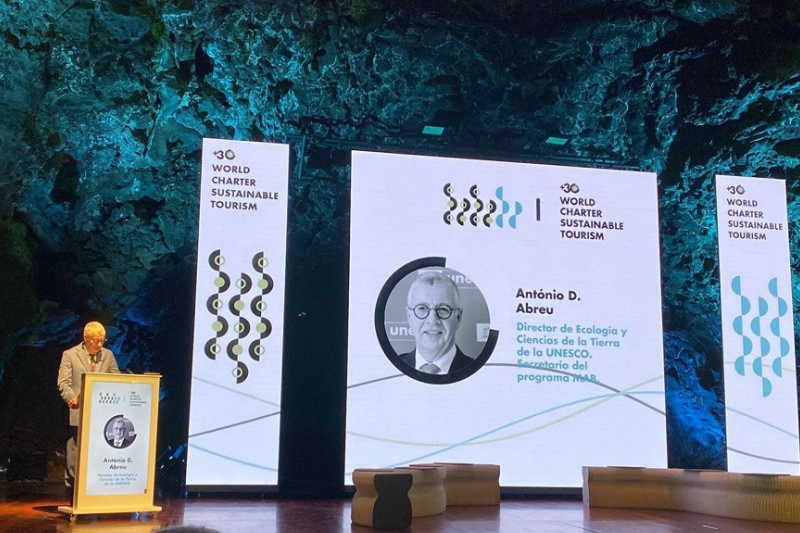
During the event, Antonio Abreu, Director of Ecological and Earth Sciences at UNESCO, delivered a deeply inspiring speech. His words resonated throughout the Jameos del Agua as a reminder that tourism, when experienced consciously, can become a true instrument of peace, dialogue, and regeneration.
Abreu emphasized that, thirty years after the first Charter for Sustainable Tourism, the journey that began in Lanzarote continues with the same conviction, stating that “tourism lived with awareness can be a space for dialogue, a declaration of hope and responsibility; another way of traveling is possible.”
Referring to the new +30 World Charter for Sustainable Tourism, he stressed that it should not be understood as just another document, but as “a declaration of hope and responsibility,” one that “invites us to transform the way we travel, the way we welcome, and the way we inhabit the planet… a charter that inspires us to see tourism as a bridge between cultures, as a tool for inclusion, and as a generative force for the ecosystems that sustain us.”
In his tribute to the host island, he expressed that “Lanzarote, a UNESCO Biosphere Reserve, is not just a setting, it is a symbol of coherence between what we say and what we do; between the art of inhabiting and the art of caring.” He added a message that connected past, present, and future, declaring that “in 1995 a dream began here; in 2015, in the Basque Country, it aligned with the Sustainable Development Goals; and today, in 2025, we transform it into a shared commitment and collective action.”
He concluded his remarks with an invitation filled with symbolism that captures the spirit of the new Charter and of the congress itself, reminding us that “sustainable tourism is not just another option, but the only responsible path toward a common future,” and calling on us to carry this charter in our memory, “to let it be a compass in every decision, an inspiration in every project, and a promise in every journey, because only if we travel with respect will we learn to inhabit with wisdom.”
The Responsible Tourism Institute (ITR), creator of the Biosphere international sustainability standard, played a prominent role in this edition.
Since its founding following the 1995 World Conference on Sustainable Tourism, the ITR has maintained an essential role in promoting, monitoring, and implementing the principles of the World Charter for Sustainable Tourism. Thirty years later, this commitment remains unwavering.
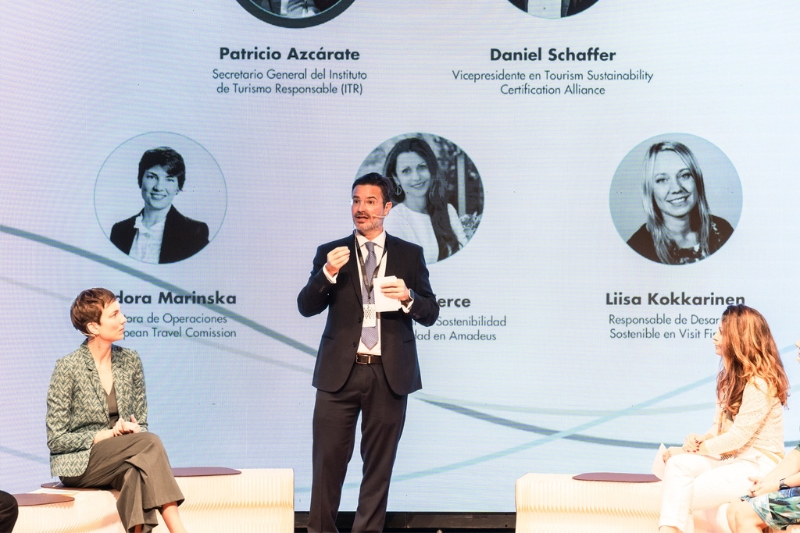
During the congress, Patricio Azcárate Díaz de Losada, Secretary General of the ITR and CEO of Biosphere, moderated Session 2 (“Transparency and Trust in Sustainable Tourism”), a segment focused on the credibility of sustainable actions and the need to strengthen trust in the sector through verifiable certifications, ethical communication, and business transparency.
According to Azcárate, “today’s traveler is increasingly demanding when it comes to sustainability, but there is still a long way to go in terms of understanding and credibility… the goal is for destinations and companies to be able to communicate sustainability in a clear, verifiable, and transparent way.”
Precisely, when asked whether travelers are increasingly demanding that their destination meet sustainability criteria and act responsibly, his answer was unequivocal: “without a doubt, yes, but there is still a path ahead; a path toward understanding what sustainable tourism truly is and how to give it credibility.”
In this regard, during his remarks, Azcárate recalled that, after the 1995 Conference organized by UNESCO in Lanzarote, the ITR was created with the purpose of translating the principles of the first charter into something tangible, giving rise to a certification process for experiences, accommodations, and tourist destinations that has evolved over time.
In this respect, he emphasized that “the goal has always been for the consumer, the tourist, to identify what sustainability truly is within the complexity of this concept.”
Azcárate also pointed to the need for different communication channels to be able to provide rigorous information about sustainability so that tourists can make conscious decisions. In his words: “when major tour operators orient their strategies toward sustainability, it is because there is a growing demand that values this commitment in their travel decisions… although we are not yet fully able to respond effectively, I am convinced that, together, within the framework of this new Charter, we will make it possible.”
For this reason, the ITR has reaffirmed its commitment to the new World Charter for Sustainable Tourism 2025, promoting its integration into the Biosphere Sustainable management and certification systems, which align the strategies of destinations, companies, and organizations with a responsible, regenerative, and transparent tourism model.
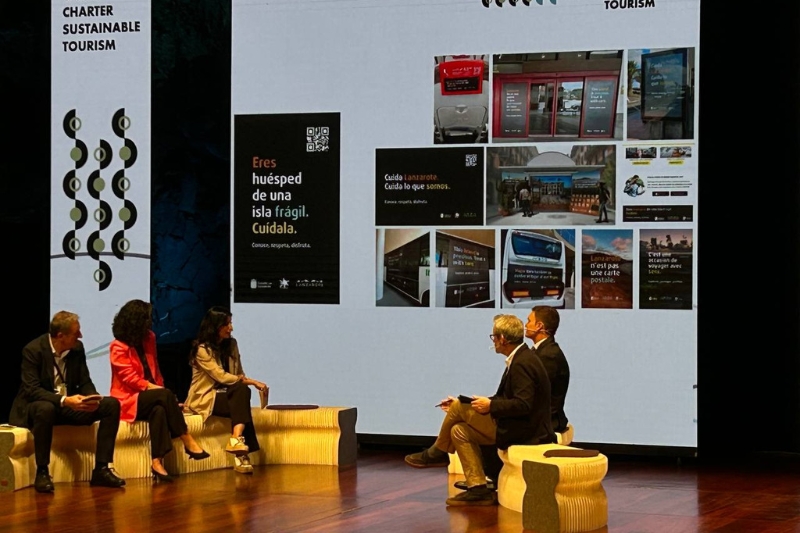
The conference program was structured around three major thematic sessions, designed to address the cross-cutting challenges and opportunities of sustainable tourism today and in the near future.
1. Overtourism: Impacts and Solutions.
This session analyzed the phenomenon of mass tourism and its effects on destinations, local communities, and ecosystems.
Speakers agreed that tourism management cannot simply focus on visitor numbers but must integrate territorial planning, environmental regulation, and community participation.
Real-world examples were shared from destinations implementing innovative strategies — from redistributing tourist flows to improving mobility systems and enacting public policies focused on livability and natural heritage protection.
2. Transparency and Trust in Sustainable Tourism.
The second session tackled one of the industry’s most sensitive issues: the credibility of sustainability practices. Experts emphasized the need for verifiable transparency — ensuring that sustainability is not just a discourse but a measurable, demonstrable practice.
Discussions covered international certifications, the responsibilities of tour operators, evolving legislation, and the ethical role of media and social platforms in promoting responsible destinations.
The conclusion was clear: trust in sustainability must be built through data, traceability, and honest communication.
3. Regeneration, Innovation, and Opportunities for Sustainable Tourism.
The final session focused on technological innovation and collaboration models already transforming the sector.
Speakers presented cases of artificial intelligence applied to tourism management, Big Data for efficient planning, circular economy projects, and carbon and clean mobility credits aimed at reducing emissions.
The discussion shifted from mitigation to regeneration — calling for tourism that leaves territories better than it found them and actively contributes to social, economic, and environmental well-being.
These panels featured international experts, institutional representatives, and business leaders, all converging on a shared message: sustainability is no longer optional — it is the only viable path for the future of tourism and destinations.
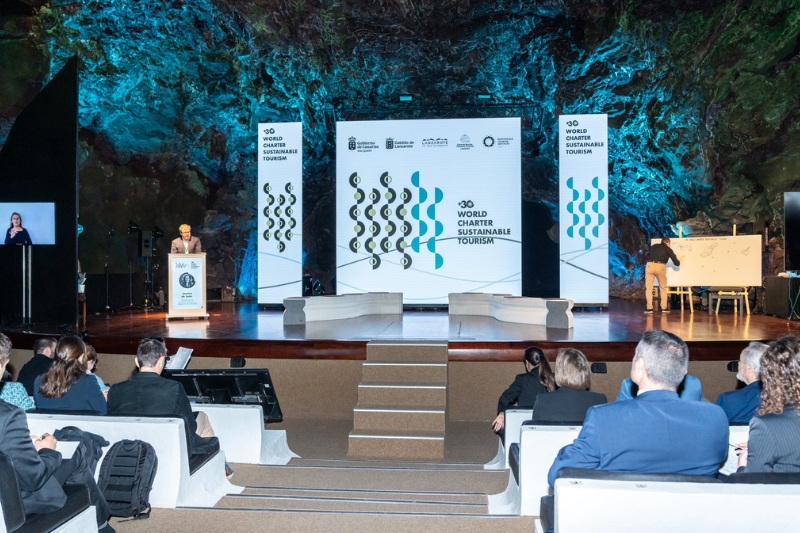
The conference concluded with a symbolic moment — the public reading of the new World Charter for Sustainable Tourism 2025 in the same location where the first Charter was proclaimed thirty years ago.
This new text, developed through a collaborative process, updates the 1995 commitments to meet today’s most pressing challenges: the climate emergency, digital transformation, social equity, and the regeneration of natural resources.
Numerous institutions, destinations, tourism entities, and international organizations have endorsed the new Charter, reaffirming their intent to apply its principles as a strategic guide in their policies and operations.
Although non-binding, it serves as a global framework for action, a shared roadmap for advancing toward a fairer, more resilient, and more conscious tourism model.
As expressed during the ceremony, the Charter is intended to be “an ethical and operational compass”, an invitation to unite efforts, share knowledge, and redefine tourism’s role as a driver of sustainable development and collective well-being.
With this reading, Lanzarote once again became the meeting point where the global tourism community looks to the future with hope, conviction, and renewed commitment.
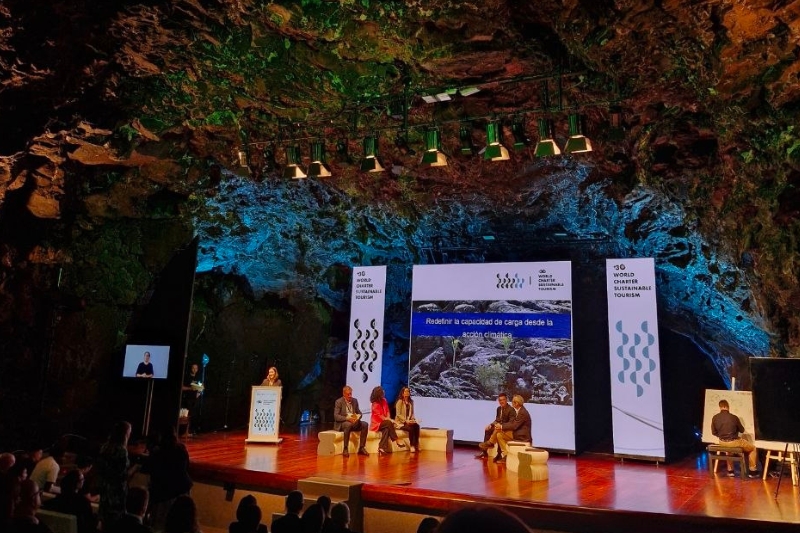
Thirty years later, Lanzarote reaffirms its position as a pioneer and international benchmark in sustainable tourism.
Its development model, based on the harmonious integration of landscape, culture, and community, remains a powerful example of vision, coherence, and long-term commitment.
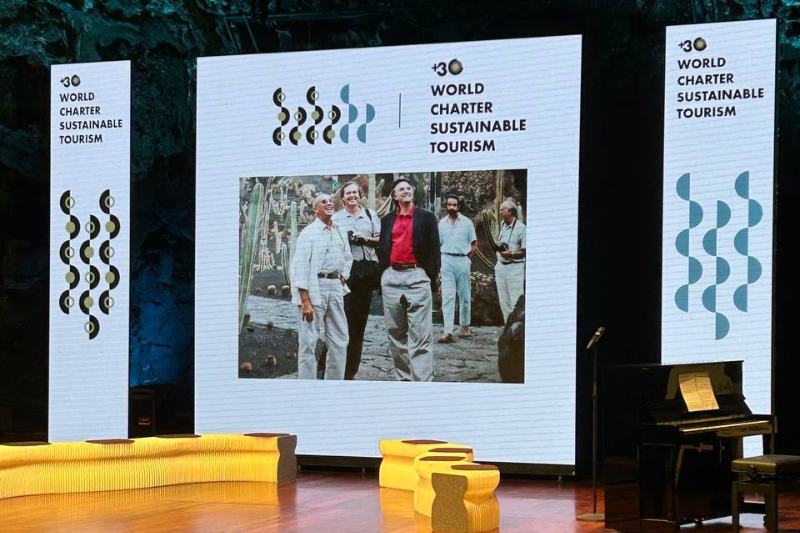
In 1995, the island hosted the First World Conference on Sustainable Tourism at the iconic Jameos del Agua — a historic event that marked a turning point in global tourism.
At that time, few associated sustainability with tourism, yet Lanzarote became the birthplace of a visionary document: the First World Charter for Sustainable Tourism, linking tourism for the first time with environmental, social, cultural, and economic sustainability.
That Charter became the first international reference framework for responsible tourism, establishing principles — such as cultural and natural heritage preservation, community participation, and social equity — that have guided the industry ever since.
Thirty years on, the World Charter for Sustainable Tourism 2025 renews that legacy, inviting us not to look back but forward — toward a more conscious, collaborative, and transformative tourism industry capable of regenerating territories, improving lives, and strengthening connections between people and places.
From this small Atlantic island, Lanzarote continues to demonstrate that another kind of tourism is possible — one that respects, protects, and shares.
Its example inspires present and future generations, reminding us that the true journey of sustainable tourism is one undertaken with purpose, responsibility, and hope.
At Biosphere and the Responsible Tourism Institute (ITR), we reaffirm our mission to promote, measure, and certify sustainability in destinations, companies, and tourism organizations worldwide, aligning their strategies with the principles of the World Charter for Sustainable Tourism 2025.
This commitment is part of our identity. The ITR’s origins are directly linked to the 1995 World Conference on Sustainable Tourism held in Lanzarote — the event that inspired its creation to promote and monitor the Charter’s principles globally.
From that same foundation, Biosphere emerged years later, designed to translate those principles into practice through tools for measuring, managing, and recognizing sustainability in a verifiable way.
Since its beginnings more than 25 years ago, Biosphere has kept alive the spirit of that first World Charter for Sustainable Tourism of 1995, also integrating the updates included in the +20 World Charter of Vitoria-Gasteiz (2015), and now renewing its commitment to the +30 World Charter for Sustainable Tourism (2025).
For Biosphere and the ITR, this new Charter represents far more than a symbolic document — it is a roadmap for transforming tourism into a true driver of shared prosperity, climate justice, and territorial balance.
Their involvement in this process has been instrumental in driving policies, strategies, and certification systems aligned with sustainability, helping consolidate a global tourism model that is transparent, responsible, and regenerative.
Participating in the 30th-anniversary commemoration of the 1995 Charter was not only a tribute to those who laid its foundations but also a reaffirmation of a shared vision for the future — a tourism that regenerates more than it consumes, promotes social inclusion, and protects both natural and cultural heritage.
Thirty years later, Biosphere and the Responsible Tourism Institute remain guided by the same conviction that began in Lanzarote: to ensure that sustainability is not merely a goal, but the path forward toward a truly transformative tourism model.
Video of the ST+30 World Conference on Sustainable Tourism
Photo: SPEL-Tourism Lanzarote