
What should you check before displaying the Biosphere label? In the context of Directive (EU) 2024/825 on environmental claims and sustainability labels, Biosphere Responsible Tourism explains its third-party certification system and the update to its certificates. Find out how to identify the scope and validity period of Biosphere Certification and access the information supporting it.
Communicating a sustainability certification requires explaining what it covers and where to find the information supporting it. Biosphere Responsible Tourism (BRT) provides information about its third-party certification system and the update to its certificates, which include the scope, validity period, and access to the public repository.
Directive (EU) 2024/825 strengthens the conditions for displaying sustainability labels in commercial communications and prohibits displaying those that are not based on a certification system or established by public authorities. In this context, Biosphere Responsible Tourism emphasizes that the use of the label by entities holding a valid Biosphere Certification must comply with its scope, the scheme's conditions of use, and applicable regulations. The validity of the certification does not, in itself, guarantee compliance with all legal requirements relating to its communication.
Information about the assessment process and access to the details of each certification make it possible to understand what supports the label and which entity, activity, or service it refers to.
In this system, the organization that defines the requirements is different from the one that assesses compliance with them. The Responsible Tourism Institute (RTI), owner of the Biosphere Scheme, establishes the requirements that entities must meet. Biosphere Responsible Tourism, as a legally separate certification body, assesses compliance with these requirements through external auditors and makes certification decisions.
This division of responsibilities separates the establishment of requirements from the assessment of compliance with them. Obtaining certification requires an external third-party audit process in which the actions taken and the evidence provided by each entity are examined.
This audit process follows the principles of ISO/IEC 17065 and does not include consulting services for the entities being assessed. Directive (EU) 2024/825 cites this standard as a reference for demonstrating the competence and independence of the third-party verifier. Following its principles is not equivalent to being accredited under the standard, nor does it, in itself, demonstrate compliance with all the Directive's requirements for certification systems.
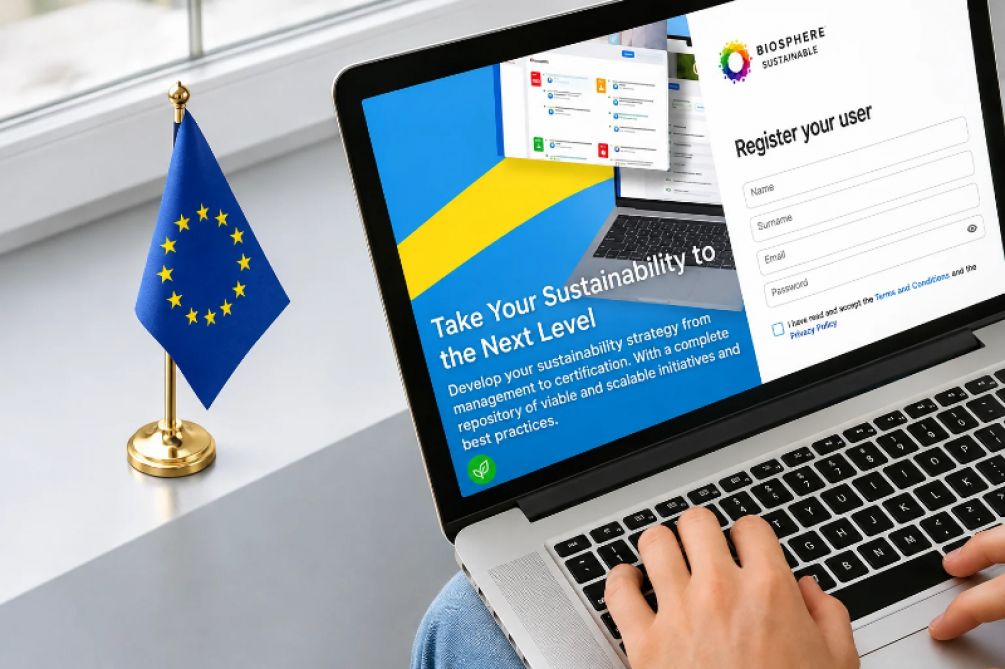
Biosphere Responsible Tourism has updated the certificates it issues to include the scope and validity period of the certification, as well as a QR code that links to the online repository. Entities can download the updated version from the Biosphere Sustainable platform.
The scope identifies what the certification covers, while the validity period makes it possible to verify its status over time. Access to the repository makes it easier to consult this information and compare it with the label displayed on a website, in marketing materials, or through another communication channel.
Entities using previous versions of the certificate can access the platform to download the updated version and review the materials in which they display their certification.
Biosphere was established in 1995 following the World Charter for Sustainable Tourism, adopted under the auspices of UNESCO and the World Tourism Organization. Since then, the Biosphere Scheme has been reviewed and adapted to the international context with the participation of stakeholders, including the United Nations Sustainable Development Solutions Network (SDSN).
Its most recent revisions, in 2015 and 2025, accompanied the renewals of the Charter, both of which were sponsored by UNESCO and, in 2015, also supported by the World Tourism Organization. These references apply exclusively to the Charter and should not be interpreted as an endorsement of each Biosphere Certification or as a guarantee of compliance with the Directive.
Entities in more than 70 countries hold a valid Biosphere Certification. In addition to this international presence, the label is recognized within the framework of Travalyst and the Tourism Sustainability Certification Alliance (TSCA), an alliance that brings together tourism sustainability certification systems from different countries.
In addition to this international presence, the certification can be displayed on booking platforms. Entities holding a valid Biosphere Certification can display the label on online travel agencies (OTAs), such as Booking.com, provided that the platform allows its publication and its conditions are met.
In their communications, the certification can also form part of the documentation supporting specific claims about aspects included within the certified scope, provided that the assessed evidence specifically supports what is being communicated. The assessment of an action does not necessarily demonstrate a quantified environmental result.
Communications must correspond to the evidence assessed, without attributing broader results than those documented or extending the certification to establishments, activities, or services that are not included. Environmental claims must specify which characteristic is being communicated and what it refers to, using clear and verifiable information. Holding certification does not, in itself, authorize the use of generic environmental claims, such as “green” or “environmentally friendly.” The Directive prohibits their use when recognized excellent environmental performance relevant to the claim cannot be demonstrated.
Therefore, before using the label, entities must verify that their certification is valid, comply with the conditions of use, and ensure that the information communicated accurately reflects their status.
Ultimately, communicating certification involves explaining what it covers, how long it remains valid, and where the supporting information can be found.
If questions arise during these checks regarding certification, updated certificates, or the use of the label, entities can contact Biosphere Responsible Tourism at the following email address: info@biospheresustainable.com.